


Healthcare App Development Cost 2026 : Pricing by App Type, Features & HIPAA Compliance
Healthcare app development in the USA costs between $35,000 and $400,000+ in 2026, depending on the app type, feature complexity, regulatory compliance requirements, and the development team’s location. A basic HIPAA-compliant MVP runs $35,000–$65,000. A full telemedicine or EHR-integrated platform ranges from $100,000 to $250,000. Enterprise-grade systems with AI diagnostics and multi-system interoperability exceed $250,000.
Understanding where your money goes is the first step to building without surprises.
What Does Healthcare App Development Actually Cost in 2026?
Healthcare apps cost significantly more than standard consumer apps because every layer of the product – backend architecture, data storage, API design, authentication – must meet standards set by HIPAA (Health Insurance Portability and Accountability Act), and in some cases GDPR (General Data Protection Regulation) and FDA SaMD (Software as a Medical Device) guidance.
These are not optional additions. They are foundational engineering decisions that must be made before a single feature is built.
Cost at a Glance by Tier
| App Tier | Cost Range | Timeline |
| Starter MVP (HIPAA-compliant) | $35,000 – $65,000 | 10–12 weeks |
| Growth (Telemedicine / EHR) | $80,000 – $160,000 | 16–22 weeks |
| Enterprise (AI / Full Interoperability) | $200,000 – $400,000+ | 28–36 weeks |
Health App MVP Cost vs. Full Product
An MVP (Minimum Viable Product) in healthtech is not a stripped-down app. It is a fully HIPAA-compliant, audit-ready build with the core user flows needed to prove clinical value. The difference in cost between an MVP and a full product comes from the number of integrations, AI features, EHR connections, and clinical workflow modules included.
A telemedicine MVP, for example, covers patient authentication, encrypted video calling, and appointment scheduling. A full telemedicine platform adds multi-provider management, EHR sync via HL7/FHIR, insurance billing, and analytics dashboards – each adding meaningful engineering hours.
Learn how we scope and deliver healthcare app MVP development in 8–12 weeks.
Healthcare App Development Cost by App Type
Telemedicine App Development Cost: $50,000–$200,000
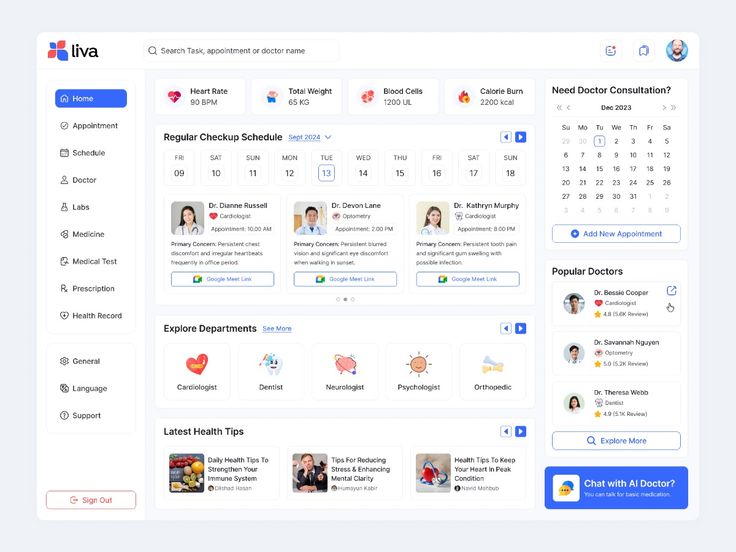
Telemedicine apps require HIPAA-compliant video infrastructure (typically built on Twilio or a BAA-covered WebRTC provider), secure in-app messaging, patient scheduling, provider dashboards, and, in many cases, payment processing via Stripe or a healthcare-specific gateway.
A basic telemedicine MVP with patient and provider portals, encrypted video, and appointment booking typically runs $50,000–$90,000. A full platform with multi-specialty support, EHR integration, and AI-assisted triage can reach $150,000–$200,000.
Our dedicated telemedicine app development team covers the full stack – from Twilio configuration to Epic FHIR endpoints.
Remote Patient Monitoring (RPM) App Cost: $80,000–$250,000

RPM apps connect to wearable devices – such as Apple Watch, Fitbit, Dexcom continuous glucose monitors, or Bluetooth-enabled blood pressure cuffs – and transmit real-time biometric data to provider dashboards. The engineering complexity lies in the device SDK integrations (Apple HealthKit, Google Health Connect), alert logic, and the real-time data pipeline required to trigger clinical notifications.
Costs increase with the number of device types supported, the complexity of clinical alert rules, and the need for CMS (Centers for Medicare and Medicaid Services) billing code compatibility for RPM reimbursement.
Mental Health and Therapy App Development Cost: $40,000–$150,000
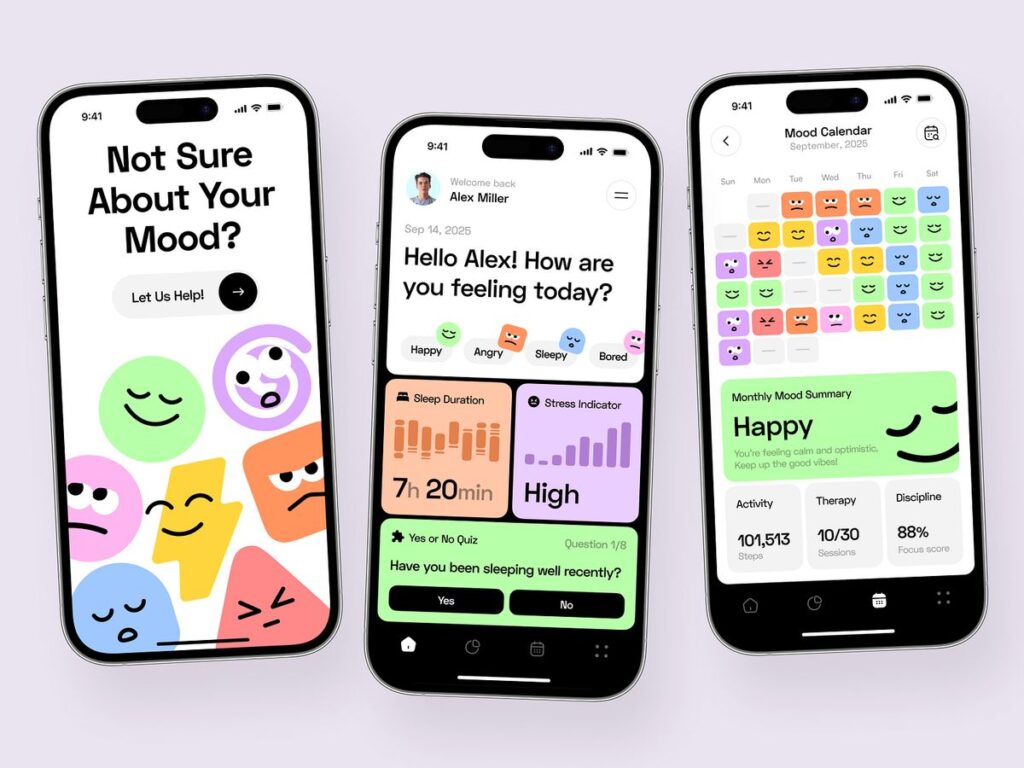
Mental health apps span a wide range, from peer-support platforms and CBT (Cognitive Behavioral Therapy) exercise tools to licensed therapist matching and synchronous video therapy sessions. Apps that handle PHI (Protected Health Information) or facilitate clinical care must be HIPAA-compliant regardless of whether they look like consumer wellness apps.
Basic wellness and mood tracking apps with no PHI exchange start around $40,000. Platforms with licensed therapist matching, video sessions, and clinical outcome tracking (using validated instruments like PHQ-9 or GAD-7) run $80,000–$150,000.
EHR and EMR Integration App Development Cost: $100,000–$400,000
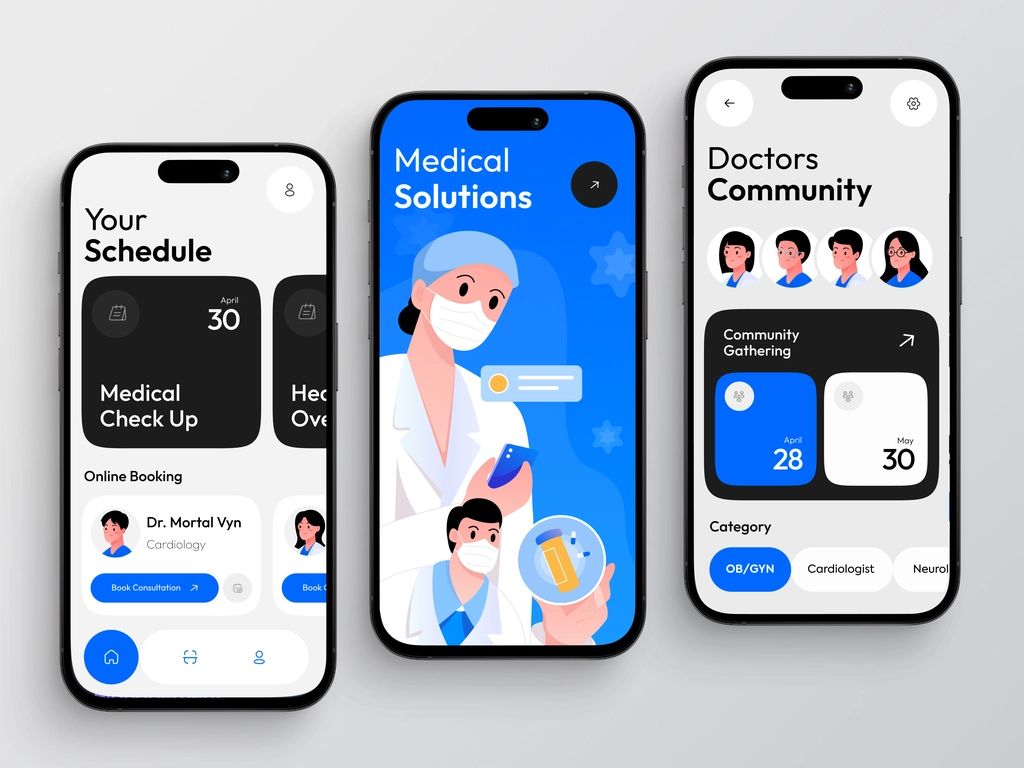
EHR (Electronic Health Record) integration is one of the most technically demanding aspects of healthcare app development. Connecting to systems like Epic, Cerner, Allscripts, or athenahealth requires implementation of HL7 v2, HL7 FHIR R4, or proprietary API layers – each with its own certification requirements and sandbox testing cycles.
The cost of EHR integration alone adds $30,000–$80,000 to a project, depending on the number of systems and the depth of data exchange required. Full EHR system development – building a net-new clinical records system – ranges from $200,000 to $400,000.
AI-Powered Healthcare App Cost: $120,000–$350,000+

AI features in healthcare apps include NLP-based symptom checkers, diagnostic imaging analysis, predictive risk scoring, and clinical decision support systems. Apps that use AI to influence clinical decisions may be classified by the FDA as Software as a Medical Device (SaMD), requiring additional regulatory documentation and potentially a 510(k) or De Novo submission.
AI feature development costs depend on whether models are pre-trained (lower cost, using OpenAI, Google Health AI, or Anthropic APIs) or custom-trained on proprietary clinical datasets (significantly higher). Model validation against real clinical outcomes adds testing time and cost.
Patient Portal App Development Cost: $50,000–$180,000
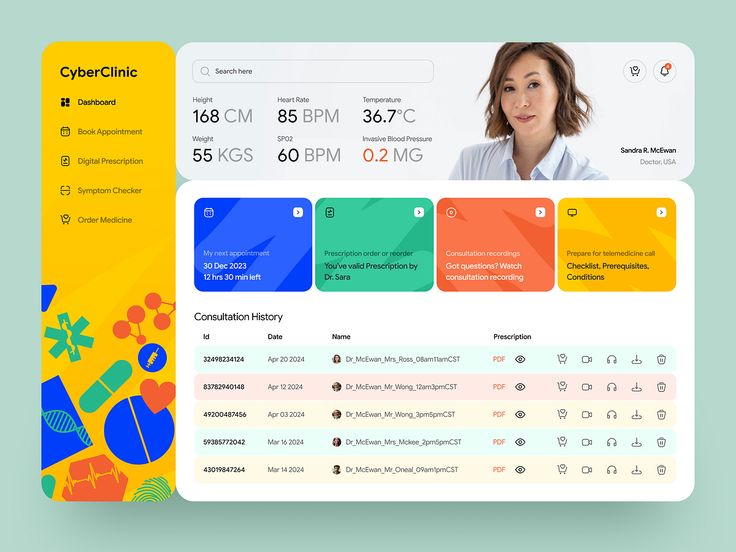
Patient portals handle digital intake, appointment scheduling, prescription refill requests, lab results access, and secure provider messaging. They must comply with the 21st Century Cures Act’s information-blocking rules, which require patient data to be available in standard formats on request.
Basic portals run $50,000–$80,000. Portals with full EHR data display, HL7 FHIR patient access APIs, and integration into existing hospital systems reach $120,000–$180,000.
Chronic Disease Management App Cost: $60,000–$200,000

Chronic disease management apps serve conditions like Type 2 diabetes, hypertension, COPD, and heart failure. They typically combine remote biometric monitoring, medication adherence tracking, care team communication, and behavioral coaching. Integration with devices like Dexcom G7 (continuous glucose monitoring) or iHealth blood pressure monitors is common.
These apps often pursue CMS reimbursement under RPM codes (CPT 99453, 99454, 99457), which adds billing module requirements. Budget $60,000–$100,000 for a focused condition-specific MVP and $120,000–$200,000 for a multi-condition platform.
Pharmacy and Prescription Management App Cost: $45,000–$160,000
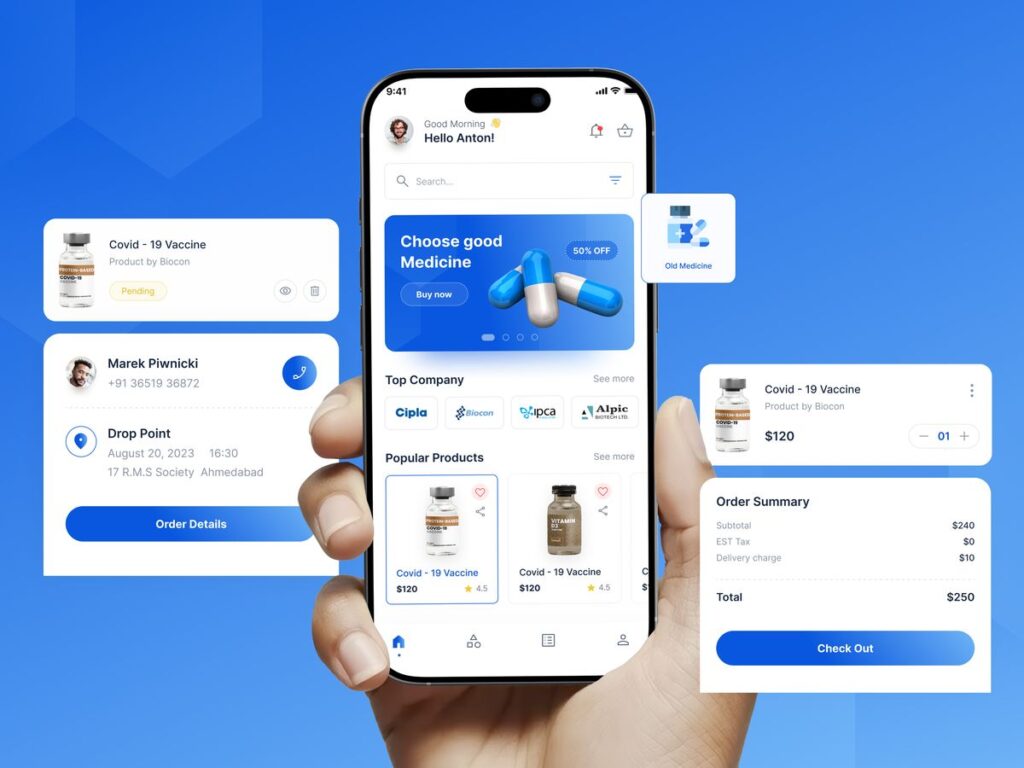
Pharmacy apps handle ePrescription workflows (using the NCPDP SCRIPT standard), medication interaction checking, refill authorization, and patient medication history. Connecting to pharmacy benefit managers (PBMs), insurance formularies, and state prescription drug monitoring programs (PDMPs) adds significant integration cost.
A basic medication reminder and refill app starts around $45,000. A full ePrescription and pharmacy management platform with PBM integration and PDMP reporting runs $100,000–$160,000.
What Drives Healthcare App Development Cost? 8 Real Factors
1. App Complexity and Number of Features
Each feature adds engineering time. Features in healthcare apps – such as encrypted video calling, biometric authentication, real-time wearable sync, or clinical alert engines – are more complex to build than their consumer equivalents because every data touchpoint must be secured and logged for audit purposes.
2. HIPAA and GDPR Compliance Architecture
HIPAA compliance is not a feature – it is an architectural requirement. AES-256 encryption at rest, TLS 1.3 in transit, role-based access controls (RBAC), PHI access audit trails, Business Associate Agreements (BAAs) with all infrastructure providers, and annual risk assessments are all required under 45 CFR Parts 160 and 164.
For apps used in the European Union or by EU residents, GDPR (General Data Protection Regulation) applies in parallel. Building for both adds 15–25% to core development cost.
Our HIPAA-compliant app development practice integrates these requirements from sprint one – not as a post-launch retrofit.
3. Native vs. Cross-Platform Development
Native iOS development (Swift, SwiftUI) and native Android development (Kotlin) produce the most performant apps and offer the deepest hardware access – critical for wearable integrations via Apple HealthKit or Google Health Connect. Native development costs roughly 30–40% more than cross-platform because two separate codebases are maintained.
Cross-platform frameworks like Flutter and React Native share a single codebase across iOS and Android, reducing cost and time-to-market without sacrificing HIPAA compliance or core security features. Most healthtech MVPs in 2026 use Flutter or React Native for exactly this reason.
See our comparison: Flutter vs. React Native 2026.
4. EHR and EMR Integration (HL7/FHIR Standards)
Integrating with Epic, Cerner, Allscripts, or athenahealth requires navigating sandbox environments, completing vendor certification programs, and maintaining version compatibility as EHR systems release updates. FHIR R4 is the current US standard mandated by CMS under the Interoperability and Patient Access Final Rule. Each new EHR connection adds $20,000–$40,000 to a project’s scope.
5. UI/UX Design Complexity for Clinical Users
Healthcare UX design serves two distinct populations with very different needs: patients (who need low-friction, accessible interfaces) and clinicians (who need information-dense, workflow-optimized dashboards). Designing for both, with accessibility compliance under WCAG 2.1 and Section 508, adds to design and QA costs.
Read more on best practices for UI/UX design in mobile apps.
6. Development Team Location: USA vs. Offshore
US-based development teams charge $150–$300 per hour. Offshore teams in India, Eastern Europe, or Southeast Asia charge $25–$75 per hour. The hourly difference is significant but does not account for the full cost picture.
HIPAA compliance in particular creates hidden offshore risk: data handling agreements, jurisdiction of PHI storage, and audit accountability are all complicated when engineering teams are outside the United States. Rework costs from compliance failures or security vulnerabilities discovered post-launch frequently eliminate the hourly savings.
7. AI, Machine Learning, and Wearable Device Integration
AI features powered by pre-trained models from providers like OpenAI or Google add $15,000–$40,000, depending on the use case. Custom model training on clinical datasets – for diagnostic imaging, risk stratification, or predictive analytics – adds $50,000–$150,000+ and requires specialized ML engineers and validated training data.
Wearable SDK integrations with Apple HealthKit, Google Health Connect, Garmin Health API, or Bluetooth medical devices add $10,000–$30,000 per device ecosystem.
8. Post-Launch Maintenance and Support
Annual maintenance for a healthcare app typically runs 15–25% of the original development cost. This covers security patching, iOS and Android OS update compatibility, HIPAA risk assessment re-certification, cloud infrastructure management, and feature iterations.
The Real HIPAA Compliance Cost Breakdown

HIPAA compliance is consistently underestimated in development budgets. It is not a single task – it is an ongoing operational framework that affects architecture, vendor selection, staff training, and annual audit cycles.
What HIPAA Compliance Adds to Build Cost
Compliance-specific engineering – encryption implementation, audit logging, RBAC, BAA negotiation with AWS or Azure, session timeout policies, and penetration testing – typically adds $15,000–$40,000 to a healthcare app’s development cost. For apps that store or transmit PHI, this cost is not avoidable.
Business Associate Agreements (BAAs)
A BAA is a legal contract required under HIPAA between a covered entity (such as a hospital or clinic) and any vendor who handles PHI. In practice, this means every infrastructure provider – AWS, Google Cloud, Twilio, Stripe, and any SaaS tool that touches patient data – must execute a BAA before the app goes live. AWS and Microsoft Azure offer BAA-covered HIPAA-eligible service tiers. Not all services within these platforms are covered, which affects architectural decisions.
Encryption, RBAC, and Audit Logging
AES-256 encryption for data at rest and TLS 1.3 for data in transit are the current minimum standards. Role-based access controls ensure that a billing administrator cannot access clinical notes, and a provider cannot access records outside their patient panel. Every PHI access event must be logged with a timestamp, user ID, and action type – these audit trails are reviewed during HIPAA audits.
Annual Risk Assessment and Re-Certification
The HIPAA Security Rule requires covered entities and their business associates to conduct annual risk assessments. In 2026, this typically involves a security audit by a qualified firm, which costs $5,000–$15,000 annually. Apps that have undergone architectural changes require a more comprehensive review.
How We Build Compliance In From Sprint One
Most agencies treat HIPAA as a compliance checklist applied after development. At Premium App Developer, compliance architecture is defined during the Discovery phase, before any feature code is written. This approach eliminates the $30,000–$80,000 retrofit cost that teams face when compliance is added after launch.
Health App MVP Cost: How to Validate Before You Overspend
A healthcare MVP is the smallest HIPAA-compliant, clinically functional version of your app that can demonstrate value to users and traction to investors. It is not a prototype. It is a production-ready product with real security architecture.
What Should Be in a Healthcare App MVP
A well-scoped healthcare MVP typically includes:
- Patient and provider authentication (biometric + MFA)
- Core clinical workflow (one of: scheduling, messaging, monitoring, or consultation)
- HIPAA-compliant data storage and encryption
- Basic analytics or reporting for the operator
- App Store and Google Play-ready build
Features that do not belong in an MVP: AI diagnostics, multi-EHR integration, billing modules, and multi-tenant architecture. These are Growth or Enterprise tier additions.
Is an 8–12 Week HIPAA-Ready MVP Actually Possible?
Yes, with the right team structure. A dedicated healthtech team – including a compliance-aware architect, one to two mobile developers, a backend engineer, and a QA specialist – can deliver a scoped HIPAA-compliant MVP in 8–12 weeks. The prerequisite is a thorough discovery and scoping phase (1–2 weeks) that eliminates ambiguity before development begins.
See: How to Build an MVP for Your Mobile App Startup
MVP Cost by App Type
| App Type | MVP Cost | Timeline |
| Telemedicine | $50,000–$80,000 | 10–14 weeks |
| Mental Health / Therapy | $40,000–$65,000 | 8–12 weeks |
| RPM / Wearable | $55,000–$90,000 | 10–14 weeks |
| Patient Portal | $45,000–$70,000 | 10–12 weeks |
| Chronic Disease Management | $55,000–$85,000 | 10–14 weeks |
Hidden Costs Most Healthcare App Budgets Miss
App Store Submission and Health App Review Requirements
Apple’s App Store and Google Play both apply heightened scrutiny to apps that claim to provide medical information, facilitate clinical communication, or handle health data. Apps in Apple’s “Medical” category require a detailed privacy policy, demo credentials for reviewers, and in some cases, documentation of regulatory clearance. Review cycles for healthcare apps average 7–14 days; rejections due to incomplete privacy disclosures or unlabeled health claims add development time.
Annual Apple Developer Program enrollment costs $99. Google Play charges a one-time $25 registration fee. Health apps frequently require re-review after significant feature updates.
Third-Party API and SDK Licensing
Twilio (HIPAA-eligible video and messaging): $0.002–$0.004 per participant per minute for video. Stripe Healthcare: Custom pricing for BAA-covered payment processing. Epic App Orchard: Certification and listing fees for third-party EHR integrations. Dexcom, Garmin, and Fitbit developer programs each have separate access requirements and, in some cases, licensing fees.
Budget $5,000–$30,000 annually for third-party API and SDK costs, depending on usage volume.
Security Penetration Testing and Vulnerability Audits
HIPAA does not explicitly require penetration testing, but it is considered industry best practice and is routinely required by healthcare enterprise clients and investors. A comprehensive penetration test for a healthcare app runs $15,000–$40,000, depending on scope. Annual security audits add $5,000–$15,000.
FDA SaMD Regulatory Documentation Costs
This is the most commonly missed budget line in healthcare app development. If your app uses AI or algorithms to support, replace, or inform clinical decisions – diagnosing conditions, recommending treatments, analyzing diagnostic images – the FDA may classify it as Software as a Medical Device under 21 CFR Part 880.
Preparing a Design History File (DHF), Software Bill of Materials (SBOM), risk analysis (ISO 14971), and Software Verification and Validation (V&V) documentation for a 510(k) submission costs $30,000–$100,000+ before FDA filing fees. Not every app needs this, but the classification decision must be made early. Misclassification leads to enforcement action.
Premium App Developer provides FDA and regulatory strategy support as part of the enterprise development process.
Post-Launch Cloud Infrastructure and HIPAA-Eligible Hosting Costs
HIPAA-eligible cloud hosting on AWS or Microsoft Azure with appropriate BAA coverage costs $500–$5,000 per month, depending on traffic, storage, and compute requirements. Key services used include Amazon EC2 (compute), Amazon RDS (relational database), Amazon S3 (encrypted object storage), and AWS CloudTrail (audit logging). For Azure, equivalent services include Azure Virtual Machines, Azure SQL Database, and Azure Monitor.
Infrastructure costs scale with user volume and are largely predictable once the architecture is defined.
Ongoing Annual Costs After Your Healthcare App Launches
| Cost Category | Annual Estimate |
| HIPAA-eligible cloud hosting (AWS/Azure) | $6,000 – $60,000 |
| Annual HIPAA risk assessment | $5,000 – $15,000 |
| Security monitoring and incident response | $3,000 – $12,000 |
| App maintenance, OS updates, bug fixes | 15–25% of the build cost |
| Third-party API licensing (Twilio, Stripe, etc.) | $5,000 – $30,000 |
| Penetration testing | $15,000 – $40,000 (every 1–2 years) |
Total annual operating cost for a mid-range healthcare app typically runs $30,000–$80,000, exclusive of new feature development.
USA vs. Offshore Healthcare App Development: True Cost Comparison
The hourly rate gap between a US-based development team ($150–$300/hour) and an offshore team in India or Eastern Europe ($25–$75/hour) appears to make offshore development 3–5x cheaper. In healthtech, that math rarely holds.
Why USA-Based Healthtech Development Often Costs Less Long-Term
HIPAA enforcement jurisdiction is US-based. When PHI is handled by an offshore team without proper data processing agreements, the covered entity (the US healthcare organization) bears the liability. The average healthcare data breach cost was $9.77 million in 2024, according to IBM’s Cost of a Data Breach Report – a figure that far exceeds any development savings.
Offshore teams with limited HIPAA familiarity frequently require significant rework when compliance gaps are identified during QA or security audits. Architecture decisions made early in development – database design, encryption implementation, access control models – are expensive to retrofit later.
Hidden Costs of Offshore Healthcare Development
- Compliance rework: $20,000–$80,000 on average for projects where HIPAA was not built in from the start
- Timezone communication delays that extend project timelines by 20–40%
- Data residency complications: PHI stored on non-US servers creates HIPAA jurisdiction risk
- Vendor liability: Offshore contractors rarely agree to US-enforceable BAAs
When Offshore Can Work in Healthtech
Offshore development is appropriate for non-PHI components: marketing landing pages, internal admin tools, and analytics dashboards with no patient data access. Core clinical features, data pipelines, and security architecture should be handled by a team with direct HIPAA experience and enforceable BAA accountability.
Premium App Developer operates as a 100% US-based team, with all development, security review, and compliance architecture handled domestically.
How to Reduce Healthcare App Development Cost Without Cutting Compliance

Start With a Scoped MVP, Not a Full Product
The most reliable way to control healthcare app cost is to define the smallest clinically useful version of the product and build that first. An MVP that validates one core workflow – for example, a telehealth consultation for a single specialty – can be launched, tested with real users, and iterated on before the full platform is funded.
Use Cross-Platform Development (Flutter or React Native)
For most healthtech startups and mid-sized practices, Flutter or React Native delivers the same HIPAA-compliant security features as native development at 30–40% lower cost. The exception is apps that require deep hardware integration – real-time ECG monitoring, advanced camera diagnostics – where native Swift or Kotlin may be required.
See: Why Cross-Platform Apps Are Gaining Popularity
Leverage Pre-Built HIPAA-Compliant APIs and Frameworks
Rather than building video infrastructure from scratch, using Twilio’s HIPAA-eligible video API saves 3–6 weeks of engineering. Similarly, using Stripe’s BAA-covered payment infrastructure, AWS’s HIPAA-eligible services, and pre-certified FHIR libraries (such as HAPI FHIR) reduces build time significantly.
Choose an Agile Partner With Sprint-Based Billing
Waterfall development contracts in healthcare frequently lead to scope creep and cost overruns when compliance requirements surface mid-project. Agile development with two-week sprints and milestone-based billing (30–40% upfront, remainder tied to approved deliverables) keeps scope transparent and costs predictable.
Invest in a Thorough Discovery Phase
A 1–2 week discovery phase – covering compliance mapping, data flow diagrams, technical architecture, and feature prioritization – costs $3,000–$8,000 but typically saves $20,000–$50,000 by eliminating ambiguity before development begins. Skipping discovery is the single most common cause of healthcare app budget overruns.
Read: Common Mobile App Development Mistakes to Avoid
Our Healthtech App Development Services: What You Get at Each Price Tier

Starter MVP: $35,000–$65,000 (10–12 Weeks)
Designed for HIPAA-compliant validation and pilot clinical testing. Includes up to 10 secure medical screens, patient authentication and encryption, basic HL7/FHIR API integration, and App Store and Google Play submission management.
Appropriate for: first-time healthtech founders, small practices digitizing one clinical workflow, pre-seed startups preparing for investor demos.
Growth Tier: $80,000–$160,000 (16–22 Weeks)
For scaling health startups that need deep EHR integration, AI features, and multi-provider workflows. Includes 20–30 screens with clinical workflows, doctor dashboard, patient analytics, secure telehealth video/audio, real-time vitals, and IoT wearable sync, and advanced AI symptom checking.
Appropriate for: Series A healthtech companies, established practices building patient-facing platforms, and telehealth operators expanding beyond a single specialty.
Enterprise: $200,000+ (28–36 Weeks)
Hospital-grade platforms for large-scale digital health ecosystems. Includes unlimited modules and custom AI models, full interoperability with Epic and Cerner, global compliance (GDPR, HIPAA, SOC 2), multi-region cloud infrastructure, and 24/7 cybersecurity and maintenance.
Appropriate for: health systems, ACOs, insurance carriers, and large multi-site medical groups.
Not Sure Which Tier Fits?
Contact our team for a free 15-minute scope call. We will assess your requirements, recommend the right tier, and provide an honest estimate – no obligation.
Real Healthcare App Cost Examples by App Type
Telemedicine MVP for a Small Practice: Real Cost Scenario
A three-physician urgent care group in Texas needed a telemedicine MVP covering patient intake, video consultation, and post-visit prescription routing – no EHR integration initially. Total build: $58,000. Timeline: 11 weeks. Stack: React Native (iOS/Android), Node.js backend, AWS HIPAA-eligible infrastructure, Twilio Video BAA, Stripe Healthcare BAA.
Mental Health App for a Startup: What $80,000 Builds
A digital mental health startup building a therapist-matching and async video therapy platform. Scope: therapist profiles, patient onboarding, HIPAA-compliant messaging, video session recording with PHI-compliant storage, and outcome tracking using PHQ-9. Build cost: $82,000. Timeline: 14 weeks. Stack: Flutter, Python/Django backend, AWS S3 with server-side encryption, Twilio Video.
Enterprise EHR Integration Platform: $250,000+ Scenario
A regional health system needed a patient engagement platform connecting to Epic via SMART on FHIR, with a patient-facing iOS and Android app, a web-based provider portal, population health analytics, and a patient communications module. Total build: $265,000. Timeline: 32 weeks. Stack: Native iOS (Swift) and Android (Kotlin), React web portal, Node.js middleware, Epic FHIR R4 APIs, AWS GovCloud.
Choosing the Right Healthcare App Development Partner in the USA

Key Questions to Ask Any Healthcare App Development Company
- Do you execute a BAA as part of the engagement?
- Is HIPAA compliance built into your sprint process or added at QA?
- Can you show a healthcare app that has passed a third-party HIPAA audit?
- Do you have experience with FHIR R4 and EHR vendor sandbox environments?
- Who owns the source code and IP upon project completion?
- What does your post-launch maintenance and re-certification process look like?
What HIPAA Expertise Actually Looks Like in a Dev Partner
A team with genuine HIPAA expertise defines data classification (PHI vs. de-identified data) during discovery. They know which AWS or Azure services require BAA coverage. They can explain the difference between HIPAA’s Privacy Rule (45 CFR Part 164 Subpart E) and the Security Rule (45 CFR Part 164 Subpart C) and how each affects app architecture. They do not treat HIPAA as a feature to be added before launch.
Why Premium App Developer Is Built for Healthtech
Premium App Developer is a US-based healthtech app development company that specializes in HIPAA-compliant platforms. Our team has delivered 73+ apps with a 94% client retention rate and an average MVP delivery timeline of 8 weeks.
Clients – including telehealth startups, dermatology practices, and mental health platforms – consistently cite compliance documentation, clean architecture, and communication as differentiators. One client reported passing a HIPAA audit on the first attempt because the compliance documentation was prepared alongside the codebase.
We offer a free strategy consultation for founders and CTOs planning a healthcare app build in 2026.
Frequently Asked Questions
How much does it cost to develop a healthcare app in 2026?
Healthcare app development costs range from $35,000 for a HIPAA-compliant MVP to $400,000+ for enterprise platforms with AI and full EHR interoperability. The median budget for a functional mid-range healthtech app is $80,000–$160,000.
What is the cost of HIPAA compliance for a healthcare app?
HIPAA-specific engineering – encryption, audit logging, RBAC, BAA negotiation, and penetration testing – adds $15,000–$40,000 to initial build cost. Annual HIPAA risk assessments and ongoing compliance maintenance cost $10,000–$30,000 per year.
How much does telemedicine app development cost?
Telemedicine app development costs $50,000–$200,000 in 2026. A basic MVP with video calling, scheduling, and patient/provider portals runs $50,000–$90,000. A full platform with EHR integration, multi-specialty support, and AI triage reaches $150,000–$200,000.
What is a realistic health app MVP cost?
A HIPAA-compliant health app MVP costs $35,000–$90,000, depending on the app type and core feature set. Telemedicine and RPM MVPs sit at the higher end of that range due to infrastructure requirements.
How much does EHR integration add to development cost?
Each EHR integration (Epic, Cerner, Allscripts) adds $20,000–$40,000 to a project’s cost, depending on the depth of data exchange and the EHR vendor’s certification requirements. Full bi-directional FHIR R4 integration with Epic is the most complex and sits at the higher end.
What are the ongoing annual maintenance costs for a healthcare app?
Annual maintenance runs 15–25% of the original build cost, covering security patching, OS updates, HIPAA re-assessment, and cloud infrastructure. For a $100,000 app, expect $15,000–$25,000 in annual operating costs before new feature development.
Can you build a HIPAA-compliant healthcare app for under $50,000?
Yes, with a tightly scoped MVP. Apps focusing on one core workflow – medication reminders, basic patient messaging, or wellness tracking without clinical claims – can be built HIPAA-compliantly in the $35,000–$50,000 range. Apps requiring video calling, EHR integration, or AI features require larger budgets.
How long does healthcare app development take in 2026?
MVPs take 8–14 weeks. Mid-range platforms with EHR integration take 16–22 weeks. Enterprise systems take 28–36 weeks. HIPAA compliance review and App Store submission add 2–4 weeks to any project timeline.
What is the difference between HIPAA compliance and FDA SaMD clearance?
HIPAA governs the privacy and security of Protected Health Information and applies to all apps that store, transmit, or process PHI. FDA SaMD clearance applies to software that functions as a medical device – specifically, apps that use algorithms to diagnose, treat, prevent, or monitor disease. A telehealth scheduling app needs HIPAA compliance. An AI-powered diagnostic imaging app may need both HIPAA compliance and FDA 510(k) clearance. The distinction must be determined early in product planning.
Related Reading
- Healthtech App Development Services
- HIPAA-Compliant App Development
- Telemedicine App Development
- MVP App Development
- How Much Does It Cost to Build an App in 2026?
- Building a Healthcare Mobile App for Small Clinics in the USA
- Flutter vs. React Native 2026
- Top Mobile App Development Trends in 2026
