

How Much Does It Cost to Build a Mobile App in 2026? (Honest Breakdown)
The first question every founder asks:
How much will this actually cost me?
You’ve got the idea. You’ve validated the market. Now you need real numbers to build your budget and pitch to investors or stakeholders. The problem? Most cost guides throw vague ranges like “$10,000 to $500,000” at you and call it a day. That’s not helpful when you’re trying to plan your runway.
Here’s the honest truth: App development costs in 2026 range from $40,000 for a simple MVP to $400,000+ for complex platforms. But where you land in that range depends on specific decisions you make early. Get them wrong, and you’ll burn cash on rework. Get them right, and you can cut your budget by 30-40% without sacrificing quality.
This guide breaks down exactly what drives mobile app development costs in 2026, compares your technology options (Flutter vs Native vs Cross-Platform), and shows you where every dollar goes. No fluff. No hidden agenda. Just the numbers you need to make smart decisions.
What Determines Mobile App Development Cost in 2026?
Before we talk numbers, understand the five factors that move your budget up or down:

1. App Complexity Level
This is your biggest cost driver. Think of it like building a house. A studio apartment costs less than
a smart mansion with automated systems.
| Complexity Level | What You Get | Cost Range | Timeline |
|---|---|---|---|
| Simple App | Login, user profiles, basic dashboard, static content | $40,000 – $100,000 | 3-6 months |
| Medium App | Payment processing, social integration, push notifications, admin panel | $100,000 – $200,000 | 6-9 months |
| Complex App | Real-time sync, AI features, AR/VR, custom animations, advanced security | $200,000 – $400,000+ | 9-12+ months |
| Enterprise | Multi-tenant architecture, scalability for millions of users, compliance-heavy | $400,000+ | 12-18 months |
2. Platform Choice: Native vs Cross-Platform
This decision alone can swing your budget by 40-60%.

Native Development means building separate apps for iOS (Swift) and Android (Kotlin).
You get maximum performance and platform-specific features, but you’re essentially paying for two apps.
Cross-Platform Development uses frameworks like Flutter or React Native to build one codebase
that runs on both platforms. This is where the savings happen.
| Development Approach | Cost vs Native | Best For | Performance |
|---|---|---|---|
| Native (iOS + Android) | 100% (baseline) | High-performance games, apps using cutting-edge device features | Maximum possible |
| Flutter | 40-60% less | Apps needing pixel-perfect UI, complex animations, brand consistency | 95% of native |
| React Native | 30-50% less | Standard business apps, teams with JavaScript expertise | 90-95% of native |
The Verdict: For 90% of apps in 2026, cross-platform is the smart financial choice. The performance gap has closed. Flutter now holds 46% market share among mobile developers, while React Native powers 12.6% of top US apps. Unless you’re building a high-frame-rate game or need deep hardware integration, go cross-platform.
3. Development Team Location

Hourly rates vary by geography more than any other factor. A senior developer in the US charges
4-5x what an equally skilled developer in Southeast Asia charges.
| Region | Hourly Rate (Mid-Level) | Cost for $100k Project | Quality Level |
|---|---|---|---|
| United States | $72-$95/hr | $100,000 (baseline) | High, strong ecosystem |
| Western Europe | $48-$65/hr | $65,000-$75,000 | High, GDPR expertise |
| Eastern Europe | $35-$52/hr | $45,000-$55,000 | High, technical depth |
| Latin America | $32-$48/hr | $40,000-$50,000 | Good, US timezone overlap |
| Southeast Asia | $22-$38/hr | $28,000-$35,000 | Good, cost-effective |
| India | $18-$34/hr | $25,000-$30,000 | Variable, vet carefully |
Smart Strategy: Many successful startups mix teams. Keep product management and UX design local (or nearshore) for alignment, while outsourcing development to Eastern Europe or Southeast Asia. This hybrid approach typically saves 30-50% while maintaining quality.
4. Feature Set and Integrations

Every feature you add has a cost. Here’s what common features run in 2026:
| Feature | Simple Implementation | Complex Implementation |
|---|---|---|
| User Authentication | $1,500 (email/password) | $12,000 (biometric, 2FA, SSO) |
| Payment Processing | $500 (Stripe redirect) | $25,000 (split payments, escrow, subscriptions) |
| Push Notifications | $2,000 (basic alerts) | $8,000 (segmented, rich media, geofenced) |
| Chat/Messaging | $4,000 (basic in-app) | $25,000 (real-time, media sharing, encryption) |
| Search | $1,500 (basic text) | $20,000 (AI-powered, vector search, filters) |
| Analytics Dashboard | $3,000 (standard metrics) | $15,000 (custom reports, real-time data) |
Pro Tip: Build an MVP with only core features first. Launch, learn, then add. Every founder tries to pack too much into
version 1.0. Uber launched without scheduled rides. Airbnb launched without online payments. Start lean.
5. Design and UX Complexity
Design isn’t just about looks. It’s about conversion, retention, and user satisfaction.
| Design Level | Cost Range | What You Get |
|---|---|---|
| Template-Based | $2,000-$5,000 | Customized UI kits, fast implementation, standard patterns |
| Custom UI/UX | $5,000-$15,000 | Unique design system, responsive layouts, accessibility compliance |
| Premium Experience | $15,000-$40,000+ | User research, micro-interactions, animations, emotional design |
For most MVPs, custom UI/UX hits the sweet spot. Template-based designs can feel generic and hurt trust. Premium design is worth it only if you’re in a competitive B2C market where “minimum lovable product” matters more than “minimum viable product.”
Honest Cost Breakdown by App Type
Instead of abstract ranges, here’s what specific app categories actually cost to build in 2026:
eCommerce/M-Commerce App
Typical Cost: $50,000 – $250,000
Timeline: 3-6 months
Core Features: Product catalog, shopping cart, payment gateway, order tracking, user profiles, admin panel
Cost Drivers: Payment security (PCI compliance), inventory management integration, scalability for traffic spikes
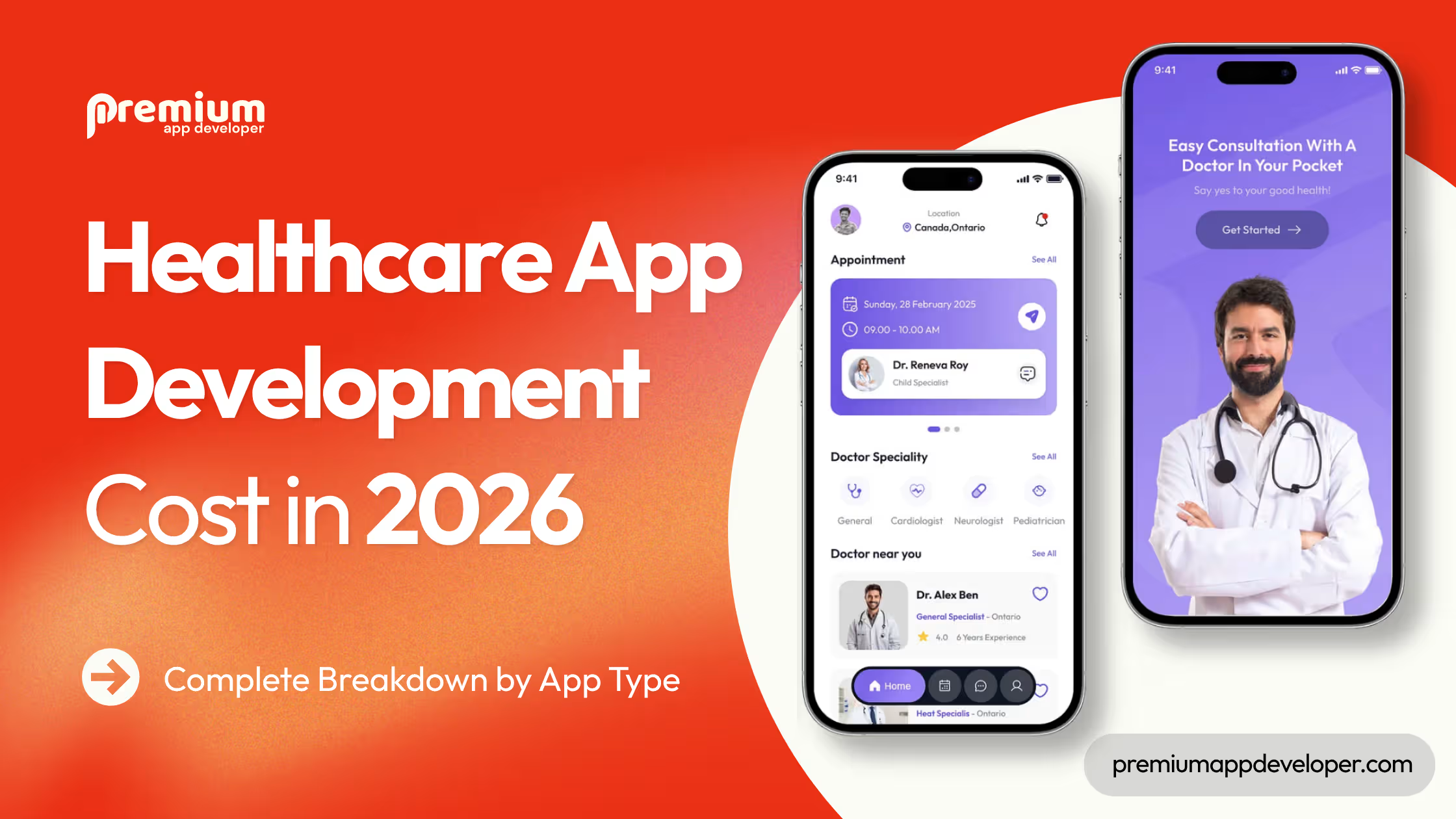
Healthcare/HealthTech App
Typical Cost: $60,000 – $400,000+
Timeline: 6-12 months
Core Features: Patient portals, appointment booking, telemedicine, health records, provider directories
Cost Drivers: HIPAA compliance, data encryption, audit trails, integration with EHR systems
Note: Healthcare apps require 20-30% higher budgets due to regulatory requirements
FinTech/Banking App
Typical Cost: $70,000 – $350,000+
Timeline: 6-12 months
Core Features: Account management, transactions, budgeting tools, fraud detection, KYC verification
Cost Drivers: Banking regulations, secure APIs, biometric authentication, compliance auditing
On-Demand Service App (Uber-style)
Typical Cost: $80,000 – $250,000+
Timeline: 4-8 months
Core Features: Real-time GPS tracking, matching algorithm, dual apps (customer + provider), payments, ratings
Cost Drivers: Real-time infrastructure, map integrations, complex backend logic for matching
Social Media App
Typical Cost: $80,000 – $300,000+
Timeline: 4-8 months
Core Features: User feeds, content creation, messaging, notifications, content moderation
Cost Drivers: Real-time data handling, media storage/CDN costs, AI moderation tools
Hidden Costs Most Founders Miss

The initial build is just the beginning. Budget for these ongoing expenses:
Post-Launch Maintenance (Annual)
Rule of Thumb: 15-20% of initial development cost per year
If your app cost $100,000 to build, budget $15,000-$20,000 annually for:
- OS updates (iOS/Android break things every year)
- Security patches
- Bug fixes
- Third-party API updates
- Server maintenance
App Store Fees
- Apple App Store: $99-$299/year (depending on program)
- Google Play: $25 one-time fee
- Transaction Fees: 15-30% of in-app purchases
Infrastructure and Hosting
| App Scale | Monthly Cost |
|---|---|
| Startup/MVP | $50-$500/month |
| Growing (10k+ users) | $500-$2,000/month |
| Scale (100k+ users) | $2,000-$10,000/month |
Marketing and User Acquisition
This is the biggest hidden cost. Many founders spend $100,000 building an app and $0 marketing it.
Realistic Budget: 50-100% of your development cost in year one for marketing, ASO (App Store Optimization), and paid acquisition.
Third-Party Services
AI/LLM APIs: $200-$5,000/month if using AI features
Analytics tools: $100-$500/month
Push notification services: $50-$200/month
SMS/Email: $50-$500/month depending on volume
Cost Comparison: Flutter vs Native vs React Native
Let’s get specific about your technology choice. Here’s how the three main approaches compare in 2026:
| Factor | Native (iOS + Android) | Flutter | React Native |
|---|---|---|---|
| Initial Cost | $100,000 (baseline) | $40,000-$60,000 | $50,000-$70,000 |
| Development Time | 6-9 months | 4-6 months | 5-7 months |
| Code Sharing | 0% (separate codebases) | 90%+ | 80-90% |
| Performance | Maximum | 95% of native | 90-95% of native |
| Hiring Ease | Moderate | Moderate (Dart required) | Easy (JavaScript) |
| Best Use Case | High-performance games | Brand-heavy apps, animations | Standard business apps |
Flutter Cost Advantage: Flutter saves 40-60% compared to native development because one Dart codebase runs on both platforms. The framework has matured significantly. With Impeller engine improvements, it now delivers 60-120 FPS performance indistinguishable from native for most use cases.
React Native Cost Advantage: React Native saves 30-50% versus native. The JavaScript talent pool is massive, making hiring easier. However, you may need native modules for complex features, which can eat into savings.
When to Go Native: Only if you’re building high-frame-rate games, AR/VR experiences, or apps requiring deep hardware integration (custom Bluetooth protocols, advanced camera processing).
The MVP Approach: Cutting Costs Without Cutting Corners
The smartest way to control costs? Build an MVP (Minimum Viable Product) first. Not a prototype.
Not a demo. A real, working product with just enough features to solve one problem well.
MVP Cost by Region (2026)
| Region | Typical MVP Cost | Timeline | Best For |
|---|---|---|---|
| US/Canada | $80,000-$250,000 | 3-6 months | Regulated industries, on-site needs |
| Western Europe | $60,000-$180,000 | 3-6 months | GDPR compliance, fintech |
| Eastern Europe | $25,000-$80,000 | 3-5 months | Complex SaaS, AI products |
| Southeast Asia | $15,000-$50,000 | 3-5 months | Budget-conscious startups |
The 60/40 Budget Rule
Never spend 100% of your budget on version 1.0. Your first version will be wrong. Not technically wrong.
Strategically wrong. Users will want features you didn’t anticipate. Bugs will appear. Markets will shift.
Smart Allocation:
- 60% for initial MVP build
- 40% reserved for iteration, bug fixes, and version 1.1
This reserve fund is your runway to pivot based on real user feedback.
How to Get an Accurate Cost Estimate
Generic ranges help with initial planning, but you need a specific number for your unique app. Here’s how to get it:
1. Define Your Feature Set (User Stories)
Break down your app into specific user actions:
- “As a user, I can sign up with email”
- “As a user, I can search products by category”
- “As an admin, I can view sales analytics”
Each story gets a time estimate. Multiply by hourly rate. That’s your development cost.
2. Choose Your Platform Strategy
- iOS only? Android only? Both?
- Native or cross-platform?
- This decision alone changes your budget by 30-60%.
3. Select Your Team Model
- Freelancers: Lower hourly rates ($30-$80), but higher management overhead
- Agency: Higher rates ($60-$150), but includes project management, QA, and continuity
- In-House: Highest long-term cost, but maximum control
4. Plan for the Full Lifecycle
Include first-year maintenance, marketing, and operational costs in your total budget. Don’t just budget for “launch.” Budget for “sustain.”
Red Flags: When a Quote Seems Too Good (or Too High)
If It’s Too Low (Under $20,000 for a Custom App)
- Template-heavy: They’re using cookie-cutter solutions that won’t scale
- Offshore risks: Communication barriers, timezone issues, code quality concerns
- Missing scope: They’re not including design, testing, or project management
- Hidden costs: Change orders will pile up later
If It’s Too High (Over $500,000 for an MVP)
- Over-engineering: They’re building for millions of users when you need hundreds
- Bloated team: Too many managers, not enough makers
- Gold-plating: Building features you don’t need for launch
- Agency overhead: You’re paying for their fancy office, not your app
The Sweet Spot
For most startup MVPs in 2026: $40,000 to $120,000 gets you a solid, market-ready product built by a professional team.
2026 Cost Trends to Watch
AI-Assisted Development: Tools like GitHub Copilot, Cursor, and AI coding agents are reducing development time by 20-40% for boilerplate code. However, this doesn’t always translate to lower costs. Senior developers using AI command higher rates, and the savings often go to faster delivery rather than lower prices.
Cross-Platform Dominance: Flutter and React Native now power the majority of new non-game apps. Native development is becoming a niche choice for specific high-performance use cases.
Rising Security Costs: With stricter data privacy laws globally, security and compliance now add 15-25% to app budgets compared to five years ago.
No-Code Limitations: While no-code tools (Bubble, Adalo) promise $5,000 apps, they hit walls quickly. For anything requiring custom logic, scalability, or unique UX, you’ll end up rebuilding from scratch. Factor in that future cost.
Bottom Line: What Should You Budget?
For a Simple MVP (3-6 months): $40,000 – $100,000
For a Medium Complexity App (6-9 months): $100,000 – $200,000
For a Complex Platform (9-12+ months): $200,000 – $400,000+
Add 20% buffer for scope changes and unexpected complexity.
Add 15-20% annually for post-launch maintenance.
The difference between a $50,000 app and a $200,000 app isn’t always quality. Often, it’s scope discipline. The founders who succeed are the ones who ruthlessly prioritize core features, launch fast, and iterate based on real user data.
Get Your Custom Cost Estimate
Every app is different. The ranges above give you a starting point, but your specific idea has unique requirements that affect pricing.
Tell us about your app idea. We’ll analyze your feature requirements, recommend the right tech stack (Flutter, React Native, or Native), and give you a detailed cost breakdown tailored to your project.